Debrief
Guzi is fandom made physical.
China’s guzi boom shows what happens when IP leaves the screen and earns a place in everyday life. Badges, acrylic stands, cards and plush toys look small. Their role is not. Guzi shows how fandom becomes identity, social currency, emotional comfort and something people carry into daily life.
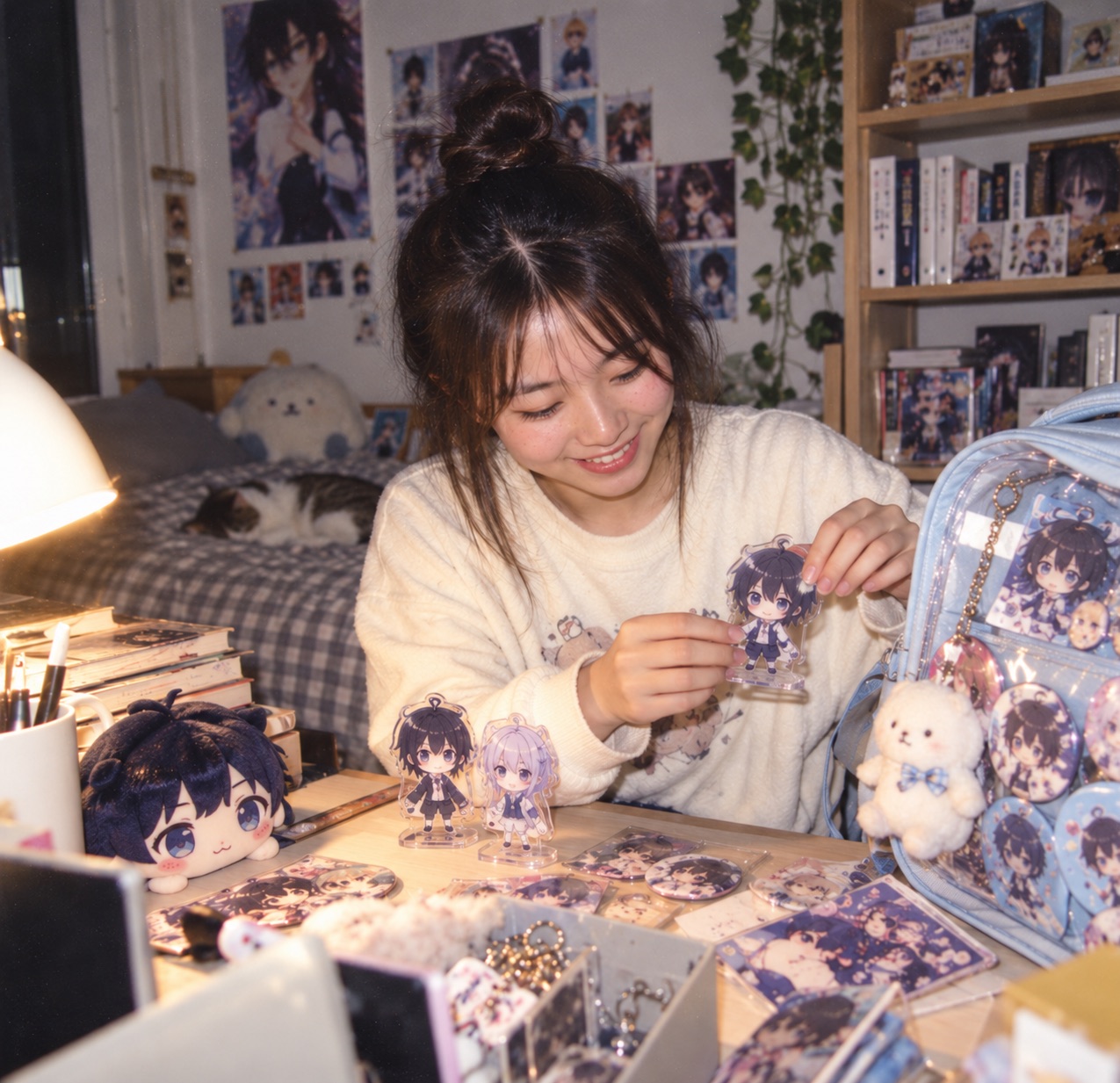
The signal
China’s guzi economy was worth an estimated RMB 168.9bn in 2024, while the wider ACG scene counted more than 500 million participants.
What we found
Guzi is the Chinese fandom economy built around small physical objects linked to IP: badges, acrylic stands, cards, keychains, plush toys, figures and other collectibles.
The word comes through Japanese グッズ (“goods”) into Chinese fan culture. What began inside anime, comics and gaming communities has moved much closer to mainstream youth consumption.
But calling guzi a toy trend misses the interesting part.
The object is often inexpensive. The meaning around it is not.
A badge can say which character you chose. An acrylic stand can turn a desk into fandom territory. An ita-bag can make private attachment publicly visible. A limited drop can create urgency, status and conversation before anyone has opened the package.
Guzi is where IP becomes behaviour.
The Famdom read
Merchandise is normally treated as something that comes after fandom.
Guzi suggests the opposite.
Physical products can actively build fandom because they give people something to collect, arrange, display, trade, photograph, gift and carry with them.
The screen creates the relationship. The object gives that relationship somewhere to live.
That matters because belonging rarely stays abstract. Families and young people turn stories into objects, routines, jokes, collections, gifts and memories. The strongest IP does not simply get watched. It travels into everyday life.
Guzi is a very visible version of that process.
The object is doing more than one job
- Emotional value: it keeps a character or story physically close.
- Identity value: it tells other people what you belong to.
- Social value: it gives communities something to compare, trade and discuss.
- Ritual value: launches, pulls, trades and displays become repeated behaviours.
- Commercial value: one IP relationship can generate many small reasons to buy again.
This is why reducing the phenomenon to blind boxes would be a mistake. The mechanics may change. The deeper need is more durable: people want ways to make belonging tangible.
What western IP owners should not copy
The obvious response is to copy scarcity, mystery boxes or collectible formats.
That is the least interesting lesson.
Guzi works because the merchandise sits on top of a relationship people already want to express. Scarcity can accelerate desire, but it cannot manufacture meaning on its own.
If the character has no role in someone’s life, another limited edition is just more inventory.
The better question is: what does this fandom want to do with its affection?
Display it? Wear it? Trade it? Gift it? Carry it to school? Put it on a desk? Meet other people through it?
That is where product strategy should begin.
What this means for family-first companies
For toy, entertainment, licensing and IP businesses, the opportunity is not simply to sell more merchandise.
It is to design the physical behaviours through which fandom can deepen.
Start with the relationship. Then design the object.
Give people accessible entry points, reasons to return, ways to display belonging and enough depth for a collection to become personal rather than purely transactional.
The most interesting part of guzi is not what people are buying.
It is what they are doing with what they bought.
Inside this Debrief
- Why low-cost objects can carry high emotional value
- How collecting turns fandom into visible identity
- Why repeat purchase is stronger when it becomes ritual
- What Western IP owners can learn without simply copying blind boxes
- How physical merchandise helps stories earn a place in everyday life
Sources and verification
- Sixth Tone, “One Piece Puzzle: How Anime Merch Found the Perfect Fit in China” (25 April 2025).
- Sixth Tone, “How China’s Love for Cute Collectibles Spiraled Into a Mania” (2 December 2024).
- South China Morning Post, “From toys to trading cards, China’s goods economy fills emotional voids, opens wallets” (12 January 2025).
Editorial note: The commercial figures cited above are secondary-source estimates reported by Sixth Tone from iiMedia Research. The strategic interpretation is Famdom’s.
Debrief completo
Get the full Debrief
Déjanos tus datos y el Debrief completo es tuyo: el trabajo de campo, los tres aprendizajes y lo que una marca hace con ellos.
Gracias.
El Debrief va de camino a tu bandeja de entrada.
No ha llegado. Revisa tus datos e inténtalo de nuevo.
Also in the Observatory
 Debrief The KIDS Act changes the brief. The KIDS Act is not mainly an age-gate story. It is a shift in who carries responsibility for digital childhood.
  Debrief PISA is not just a school score. The 2025 results point beyond classrooms: attention, AI, attendance and family support are now part of the same learning system.
Questions about this piece
What is guzi?
Guzi is the Chinese fandom economy built around small physical objects linked to IP: badges, acrylic stands, cards, keychains, plush toys, figures and other collectibles. The word comes through the Japanese word for “goods” into Chinese fan culture. It began inside anime, comics and gaming communities and has moved much closer to mainstream youth consumption.
Why does guzi matter for family-first companies?
It shows that physical products can actively build fandom, not just follow it, because they give people something to collect, arrange, display, trade, photograph, gift and carry. For toy, entertainment, licensing and IP businesses, the opportunity is not simply to sell more merchandise. It is to design the physical behaviours through which fandom can deepen: start with the relationship, then design the object.
Should Western IP owners copy blind boxes and limited drops?
Not as a shortcut. Copying scarcity, mystery boxes or collectible formats is the least interesting lesson. Guzi works because the merchandise sits on top of a relationship people already want to express. Scarcity can accelerate desire, but it cannot manufacture meaning on its own. If a character has no role in someone’s life, another limited edition is just more inventory.